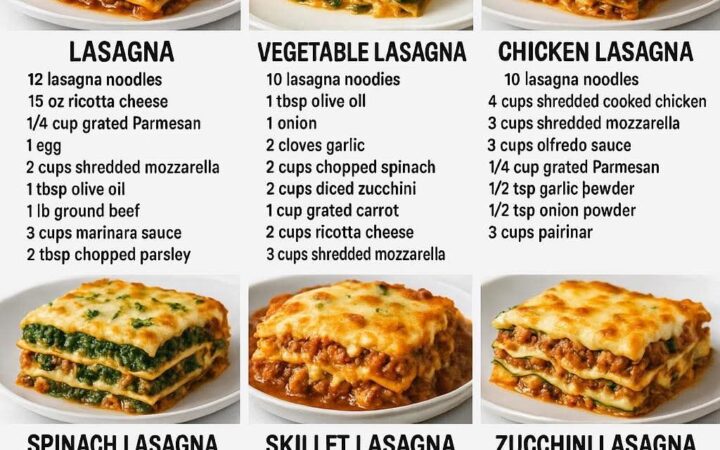
Italian Lasagne is a layered bake of egg pasta sheets, slow-simmered meat ragu, creamy besciamella, and a mozzarella-parmesan top. It is the most requested dish in my kitchen, and it is not difficult – it is just sequential. Get the ragu right, keep the besciamella loose, and the assembly takes 8 minutes.
Advertisements1
The numbers matter here. My ragu simmers 60 minutes uncovered to reduce from about 6 cups to 4 cups of thick sauce. Any wetter and the pasta floats; any drier and the layers stay chalky. The bake runs 35 minutes at 375F (190C), then 10 minutes of resting so the slices hold their shape on the plate.
– Total time: about 1 hour 50 minutes, of which 35 minutes is hands-off oven time. – Yields a 9×13 inch (23×33 cm) pan, 6 generous servings at roughly 285 calories each. – Make the ragu up to 3 days ahead; the flavor actually improves on day two.
Why You'll Love This Recipe
About the Ingredients
1 lb (450 g) ground beef, 80/20 lean-to-fat
80/20 gives more flavor than 90/10 and renders enough fat to start the soffritto. Substitute half ground pork for a sweeter, richer ragu.
1 lb (450 g) mild Italian sausage, casings removed
Mild keeps the heat low so the tomatoes read clearly. Hot sausage works, but cut the red pepper flakes to a pinch.
1 large onion, 1 carrot, 2 celery stalks, all finely diced (about 2 cups soffritto)
This is the classic Italian base; keep the dice under 1/4 inch so it melts into the sauce. No celery? Use 1/2 fennel bulb.
4 cloves garlic, minced
Add at the end of the soffritto so it browns for 30 seconds, not 3 minutes. Jarred garlic is acceptable but tastes flatter.
2 cans (28 oz / 800 g each) whole peeled San Marzano tomatoes, hand crushed
Crush by hand for texture; a blender makes the sauce watery. If San Marzano are unavailable, look for any whole peeled tomato with no added calcium chloride.
2 tbsp double-concentrated tomato paste
Fry it 1 minute with the meat to kill the raw tin taste. Tube paste beats canned for this.
1 1/2 tsp kosher salt, 1 tsp black pepper, 1 tsp dried oregano, 1/2 tsp red pepper flakes
Season the ragu in layers, not at the end. If using table salt, drop to 1 tsp total.
6 tbsp (85 g) unsalted butter
Butter, not oil, for the besciamella – it browns predictably and tastes cleaner. Salted butter means cutting the added salt.
3/4 cup (95 g) all-purpose flour
Weigh it; a packed cup can hit 130 g and turn the sauce to paste. Bread flour works but thickens faster.
6 cups (1.4 L) whole milk, warmed
Warm milk prevents lumps. 2% works with a slightly thinner result; do not use skim.
1/4 tsp nutmeg, freshly grated
A little goes far; pre-ground nutmeg is roughly half as potent. Grate over the finished sauce, not into the roux.
12 oz (340 g) no-boil lasagne sheets, plus 3 cups (300 g) shredded low-moisture mozzarella and 1 1/2 cups (150 g) grated Parmigiano-Reggiano
Low-moisture mozzarella prevents a watery top; fresh mozzarella must be drained and patted dry. Parmigiano can be swapped for Grana Padano at lower cost.
Tips & Tricks
- Do not skip the 60-minute uncovered simmer. A watery ragu is the number one cause of soupy lasagne, because no-boil sheets pull moisture from the sauce during the bake.
- Make the besciamella pourable, not stiff. It should coat a spoon but still ribbon off it; thick besciamella cannot spread over dry pasta sheets and leaves them chalky.
- Rest 10 minutes before slicing. The layers set as the starch cools, and an immediate cut collapses into a pile on the plate.
- Salt the ragu less than you think. The Parmigiano and mozzarella add roughly 1.5 g of sodium per serving, and the sauce concentrates as it reduces.
Pro Tips
Step-by-Step Instructions
1. Build the soffritto
Heat 2 tbsp olive oil in a 6-quart Dutch oven over medium heat (about 350F / 175C) and cook the onion, carrot, and celery for 8 minutes until soft and translucent, not browned. Add the garlic and cook 30 seconds until fragrant.
2. Brown the meat
Add the beef and sausage, breaking it into 1/2-inch crumbles, and cook 8 to 10 minutes over medium-high heat until no pink remains and the edges are browned. Stir in the tomato paste and cook 1 minute until it darkens to brick red.
3. Simmer the ragu
Add the crushed tomatoes, salt, pepper, oregano, and pepper flakes. Bring to a bare simmer, then cook uncovered 60 minutes over low heat, stirring every 10 minutes, until reduced to about 4 cups and a spoon dragged across the pot leaves a clean trail.
4. Make the besciamella
In a separate saucepan, melt the butter over medium heat, whisk in the flour, and cook 2 minutes until pale blond and smelling of toasted bread. Whisk in the warm milk in a steady stream and cook 6 to 8 minutes, whisking, until it coats a spoon at 180F (82C). Off heat, stir in the nutmeg and 1/2 tsp salt.
5. Preheat and prep
Heat the oven to 375F (190C) with a rack in the middle. Grease a 9×13 inch (23×33 cm) pan and spread 1/2 cup of ragu across the bottom.
6. Layer the lasagne
Layer in this order: 4 pasta sheets, 1 1/2 cups ragu, 1 cup besciamella, 1/2 cup mozzarella, 1/4 cup Parmigiano. Repeat twice, then finish with the remaining pasta, ragu, besciamella, mozzarella, and Parmigiano.
7. Bake covered, then uncovered
Cover with foil and bake 25 minutes at 375F (190C). Remove the foil and bake 10 to 12 minutes more until the top is golden brown and the edges bubble steadily. An instant-read thermometer in the center should read 165F (74C).
8. Rest and slice
Rest the pan on a wire rack 10 minutes. Cut into 6 portions with a serrated knife, wiping the blade between cuts, and serve with the pan juices spooned over.
Delicious Variations
Vegetarian Mushroom Lasagne
Swap the meats for 2 lb (900 g) mixed mushrooms browned hard in batches, and add 1 tbsp soy sauce to the ragu for the missing savory depth.
Spinach and Ricotta Version
Replace 1 cup of the besciamella with 2 cups (500 g) whole-milk ricotta mixed with 10 oz (280 g) squeezed chopped spinach; the result is tangier and lighter.
White Chicken Lasagne
Use 1 1/2 lb (680 g) shredded rotisserie chicken, skip the tomatoes, and double the besciamella with 1/2 cup dry white wine added to the roux.
How to Store Italian Lasagne
Refrigerator
Cool within 2 hours, cover tightly, and refrigerate up to 4 days. Slice first – whole-pan reheating takes twice as long.
Freezer
Wrap the unbaked or fully baked lasagne tightly in plastic, then foil, and freeze up to 3 months. Baked lasagne freezes better than unbaked because the pasta has already absorbed its liquid.
Reheating
From the fridge, cover with foil and bake at 350F (175C) for 25 minutes, then uncover 5 minutes. From frozen, add 45 minutes covered at 350F (175C), then 10 minutes uncovered.
Frequently Asked Questions
Q: Do I have to boil no-boil lasagne sheets?
No, but you must give them enough liquid to hydrate. Use a ragu reduced to about 4 cups and a pourable besciamella, and the sheets soften fully in the 35-minute bake. If your sauce is thin, soak the sheets in hot water for 5 minutes before layering.
Q: Why is my lasagne watery?
Watery lasagne almost always means an under-reduced ragu or undrained mozzarella. Simmer the sauce uncovered until a spoon trail stays clean, and use low-moisture mozzarella or pat fresh mozzarella dry. Resting 10 minutes before cutting also stops liquid from pooling on the plate.
Q: How many layers should lasagne have?
Three pasta layers is the sweet spot for a 9×13 inch pan. More layers compress under their own weight and the bottom sheet turns to paste; fewer layers and the ratio of sauce to pasta gets soupy.
Q: Can I make lasagne ahead of time?
Yes, assemble it up to 24 hours ahead, cover, and refrigerate. Add 10 minutes to the covered bake time because the pan starts cold, and do not let it sit at room temperature longer than 2 hours. The ragu alone can be made 3 days ahead.
Q: What is the internal temperature of a finished lasagne?
The center should reach 165F (74C) on an instant-read thermometer. At that point the cheese is fully melted and the layers are heated through; anything below 150F (66C) means a cold middle.
Make the ragu on Saturday, assemble on Sunday, and you have a pan that feeds six with leftovers for two lunches. Weigh the flour, reduce the sauce fully, and rest the pan – those three moves decide the outcome. Stay sharp.

Italian Lasagne
Italian Lasagne with slow simmered meat ragu, creamy besciamella and three cheeses, baked until bubbling for a rich Sunday dinner.
🧂 Ingredients
- 1 lb (450 g) ground beef, 80/20 lean-to-fat
- 1 lb (450 g) mild Italian sausage, casings removed
- 1 large onion, 1 carrot, 2 celery stalks, all finely diced (about 2 cups soffritto)
- 4 cloves garlic, minced
- 2 cans (28 oz / 800 g each) whole peeled San Marzano tomatoes, hand crushed
- 2 tbsp double-concentrated tomato paste
- 1 1/2 tsp kosher salt, 1 tsp black pepper, 1 tsp dried oregano, 1/2 tsp red pepper flakes
- 6 tbsp (85 g) unsalted butter
- 3/4 cup (95 g) all-purpose flour
- 6 cups (1.4 L) whole milk, warmed
- 1/4 tsp nutmeg, freshly grated
- 12 oz (340 g) no-boil lasagne sheets, plus 3 cups (300 g) shredded low-moisture mozzarella and 1 1/2 cups (150 g) grated Parmigiano-Reggiano
📋 Instructions
- 1Build the soffritto — Heat 2 tbsp olive oil in a 6-quart Dutch oven over medium heat (about 350F / 175C) and cook the onion, carrot, and celery for 8 minutes until soft and translucent, not browned. Add the garlic and cook 30 seconds until fragrant.
- 2Brown the meat — Add the beef and sausage, breaking it into 1/2-inch crumbles, and cook 8 to 10 minutes over medium-high heat until no pink remains and the edges are browned. Stir in the tomato paste and cook 1 minute until it darkens to brick red.
- 3Simmer the ragu — Add the crushed tomatoes, salt, pepper, oregano, and pepper flakes. Bring to a bare simmer, then cook uncovered 60 minutes over low heat, stirring every 10 minutes, until reduced to about 4 cups and a spoon dragged across the pot leaves a clean trail.
- 4Make the besciamella — In a separate saucepan, melt the butter over medium heat, whisk in the flour, and cook 2 minutes until pale blond and smelling of toasted bread. Whisk in the warm milk in a steady stream and cook 6 to 8 minutes, whisking, until it coats a spoon at 180F (82C). Off heat, stir in the nutmeg and 1/2 tsp salt.
- 5Preheat and prep — Heat the oven to 375F (190C) with a rack in the middle. Grease a 9×13 inch (23×33 cm) pan and spread 1/2 cup of ragu across the bottom.
- 6Layer the lasagne — Layer in this order: 4 pasta sheets, 1 1/2 cups ragu, 1 cup besciamella, 1/2 cup mozzarella, 1/4 cup Parmigiano. Repeat twice, then finish with the remaining pasta, ragu, besciamella, mozzarella, and Parmigiano.
- 7Bake covered, then uncovered — Cover with foil and bake 25 minutes at 375F (190C). Remove the foil and bake 10 to 12 minutes more until the top is golden brown and the edges bubble steadily. An instant-read thermometer in the center should read 165F (74C).
- 8Rest and slice — Rest the pan on a wire rack 10 minutes. Cut into 6 portions with a serrated knife, wiping the blade between cuts, and serve with the pan juices spooned over.

Liam covers personal finance for young professionals, with a no-nonsense approach to budgeting and investing. He shares strategies he's tested while paying off his own student loans.